


Can Trees Really Control Erosion? Natural Stabilization Techniques That Work
Can Trees Really Control Erosion? Natural Stabilization Techniques That Work
Erosion is one of the most persistent challenges facing developers, engineers, and landowners across Texas. Whether on a steep residential slope, a drainage easement, or a creek-side development, unstable soils can cause significant structural damage, soil and water contamination, stormwater complications, and environmental degradation.
While hardscaping solutions like retaining walls and gabions are common, there’s a quieter hero in erosion control: trees. Their root systems stabilize soil, absorb excess water, and buffer slopes against degradation. In this article, Tree Mann Solutions explores how trees—and smart arboricultural planning—can provide effective, natural erosion control across diverse site conditions.
Why Erosion Happens
Soil erosion occurs when wind, rain, or runoff dislodges and moves soil particles from one area to another. Key contributors include:
– Lack of vegetative cover
– Compacted or disturbed soil
– Steep slopes without stabilization
– Concentrated runoff from impervious surfaces
– Channelization near creeks or swales
Erosion leads to sedimentation in storm drains, slope failure, increased landscaping costs, , and property loss.
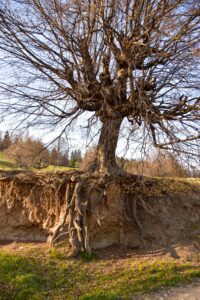
How Trees Prevent Erosion
- Root System Reinforcement
Tree roots bind soil particles together, increasing slope stability and reducing shear stress. Fibrous roots (e.g., from cedars and willows) are especially effective. - Water Uptake and Interception
Tree canopies slow rainfall before it hits the ground, reducing surface splash. Roots absorb water, lowering runoff volume and peak flow. - Wind and Flow Buffers
Trees planted along slopes or water channels disrupt wind and slow water movement, minimizing soil detachment. - Surface Roughness
Leaf litter and understory vegetation associated with trees add texture to the ground, reducing erosion velocity.


Best Tree Species for Erosion Control in Texas
– Bald Cypress: Excellent for streambanks and floodplains
– Eastern Red Cedar: Strong wind buffer with fibrous roots
– Live Oak: Anchors well in clay soils
– Black Willow: Perfect for wet or seasonal runoff areas
– American/Mexican Sycamore: Large canopy with excellent soil hold
-Ash Juniper: They have a very efficient root system that retains water
-Green Ash; Helps hold up river banks and sustain soil structures in riparian areas
Each site should be matched with species suited to its environmental conditions, soil type, and space constraints
When to Use Trees vs. Hardscapes
Trees are ideal for:
– Long-term slope stabilization
– Riparian buffer restoration
– Residential hillsides and terraces
– Large detention or drainage areas
– Supplementing infrastructure
Hardscapes may be necessary for:
– Acute erosion zones with fast-moving water
– Vertical or heavily built-up embankments
– Emergency stabilization before planting
Tree Mann Solutions collaborates with design teams to develop sustainable systems where structural elements stabilize the site short-term while trees and vegetation take over for long-term health.
Designing for Success
- Site Assessment
Begin with a slope and soil stability assessment. Our arborists identify existing vegetation, soil type, and failure risk. - Strategic Planting
Trees should be spaced to maximize canopy coverage and root overlap. Mulching and erosion blankets help establish seedlings. - Protecting Critical Root Zones
Construction should avoid root compaction. Root barriers and staged planting can support soil integrity during grading. - Monitoring and Maintenance
Regular watering during establishment, protection from deer or mower damage, and pruning are key to long-term success.
Trees are more than landscape features—they’re structural allies in the fight against erosion. With the right species, placement, and maintenance, trees can serve as long-lasting, low-maintenance soil stabilizers for Texas properties.
If your site struggles with slope instability or stormwater erosion, contact Tree Mann Solutions to explore natural alternatives to concrete. Let’s make the world greener!
Share this Post

