


Tree Surveys: The First Step Every Developer Should Take Before Breaking Ground
Tree Surveys: The First Step Every Developer Should Take Before Breaking Ground
In the ever-evolving landscape of real estate development across Texas, one foundational step often determines the success or failure of an entire project: the tree survey. Long before site clearing or construction begins, a comprehensive understanding of the site tree population provides developers with essential data for regulatory compliance, sustainable design, and budget forecasting.
Tree surveys, when conducted by Certified Arborists, are more than a list of tree species—they’re a roadmap to navigating local ordinances, mitigating risk, and aligning with environmental best practices. At Tree Mann Solutions, we help developers identify the value of trees as both natural assets and potential constraints. This article explores why tree surveys are essential, how they work, and what benefits they offer to forward-thinking development teams.
What Is a Tree Survey?
A tree survey is a detailed assessment of trees on a parcel of land, ideally conducted by an ISA Certified Arborist. Each tree is evaluated based on several criteria, including:
– Species identification
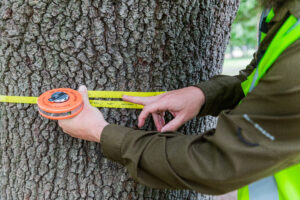
– Trunk diameter (DBH – diameter at breast height)
– Health and structural condition
– Location coordinates
– Notes on environmental context and construction impact potential
This data is used to determine which trees are protected under local ordinances, which ones should be preserved, which ones may be candidates for removal, and the associated mitigation rate for removal (full, reduced, or potentially no mitigation based on condition). In most municipalities, especially in urban and rapidly growing regions like Austin, Dallas, Houston, and San Antonio, submitting a tree survey is a prerequisite for building permits.
The Compliance Factor: Navigating Tree Ordinances
Texas municipalities vary widely in how they regulate trees, but many have robust preservation laws. For example:
– Austin’s Tree Ordinance requires permitting for the removal of “Protected Trees” with a DBH of 19” or greater.
– Dallas mandates mitigation for the removal of protected species 8” and larger and outlines specific valuation formulas.
– San Antonio classifies certain small tree species (Texas redbud, Texas mountain laurel, Texas persimmon etc.) as “Heritage Trees” at a DBH of 12” or greater while larger “Heritage Trees” require a DBH of 24” or greater.
Failing to include a tree survey in your permit submission—or submitting an inaccurate one—can delay your project by weeks or months. It can also result in penalties, including mandatory replanting or fines.
The Developer’s Dilemma: Why Tree Surveys Save Time and Money
From a business perspective, tree surveys can seem like one more bureaucratic hurdle. But in reality, they provide cost-saving and value-enhancing benefits:
1. Avoid Redesign Costs: Catching ordinance-protected trees early allows architects and engineers to adjust site plans proactively, avoiding expensive redraws.
2. Minimize Mitigation Fees: Knowing which trees require mitigation based on their size, species, and condition allows developers to factor fees into their budgets and explore cost-saving alternatives, such as on-site replanting and understory tree credits.
3. Reduce Legal Risk: Having a certified, timestamped survey offers protection against claims of ordinance violations.
4. Improve Community Relations: Developers that respect the canopy often enjoy smoother approvals from local boards and more goodwill from the community.
Tree Mann’s Approach: Precision Meets Permitting
At Tree Mann Solutions, our approach to tree surveys emphasizes both technical accuracy and regulatory alignment. Our Certified Arborists work directly with developers, surveyors, and civil engineers to provide reports that integrate seamlessly into CAD or GIS systems. We tailor every survey to the unique requirements of each municipality.
Our services include:
– Full site walkthroughs, tree tagging, accurate measurements/species identification., and photo documentation of each tree
– Ordinance-specific reporting formats
– Tree condition evaluations with preservation recommendations
– Mapping files for planners and engineers
– Support during permitting and construction
When paired with our consulting services, these surveys become tools for proactive design, not just regulatory compliance.
Timing Matters: When to Conduct a Tree Survey
Ideally, a tree survey should be conducted **before or during the land survey and site planning phase**. Waiting until just before construction can lead to conflicts between planned improvements and protected trees, especially in areas with large root zones or heritage specimens.
Working with a consulting arborist early allows developers to:
– Incorporate tree data into preliminary grading and drainage plans
– Identify potential conflicts with driveways, utilities, and sidewalks
– Preserve high-value specimens through slight layout shifts
Tree surveys are more than a regulatory requirement—they are a strategic advantage for developers who want to stay compliant and build smarter. From ordinance navigation to site design optimization, a properly executed tree survey is one of the most valuable tools in a developer’s toolbox.
Whether you’re planning a single residential lot or a multi-acre commercial site, Tree Mann Solutions provides the insight, experience, and technical reporting to help you break ground with confidence.
Ready to get started? Contact Tree Mann Solutions today to schedule your tree survey with one of our Certified Arborists.
Share this Post

